The History of Measurement
| Level: Beginner | Duration: NA |
| Grade Level: 3rd grade and up | Author: LEGO Education |
| Topics: Early forms of measurement; accuracy | |
| Materials: Simple and Motorized Mechanisms Base Set | |
| References / Resources: | |
Objective
Students learn early forms of measurement and explore why many are considered inaccurate.Description
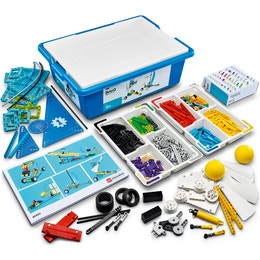
Today we are fortunate enough to have a standardized system of measurement, but it wasn't always that way. Many early cultures used body parts to figure distances! Could this have caused any problems? Students will use the Simple and Motorized Mechanisms Base Set to build a trundle wheel and determine the inaccuracies that occurred in early forms of measurement.Procedures
Before class begins:
- The teacher determines the number of teams the students will be divided into. This may depend upon either the number of students in the class or sets available for use (this particular set is designed for teams of 2 students but can be adjusted for this activity as needed).
- The teacher determines the measurements that he or she would like the students to explore. The chosen measurements should be written either on the board or on a piece of paper that can be photocopied and handed out to each group. Students need to be given both the measurement units and the definitions, as they will most likely be unfamiliar with the majority of them.
Suggestions for possible measurement units and definitions:
- Cubit - used in the Noah's-ark time period, this was the distance from the tip of the elbow to the end of the middle finger
- Fathom - used thousands of years ago, this was the distance across outstretched arms
- Span - the distance from the tip of the thumb to the tip of the little finger when the fingers are spread out as far as possible
- Half a span - distance across a hand
- Pace - used by the early Roman soldiers, this was the distance covered from the time one foot touched the ground until that same foot touched the ground again, or the length of a double step
- Foot - in early times, this was the actual length of an individual's foot
- Inch - was originally considered to be the width of a man's thumb
- Each of the groups of students will also need to be given a copy of the measuring wheel handout that is attached to this activity.
During class activity:
- After being placed in groups, the students will use the building guides included in the set to build the Trundle Wheel model. If building the model takes a considerable amount of time, this activity can be split into two different class sessions: building can take place in the first session or day, and the rest of the activity can be done in the second session or day.
- In addition to building, the students will also need to trace the wheel provided on the attached handout. This can be done on either a separate piece of paper or can be done on the plastic wheel provided in the set. This wheel must then be placed on the finished model as it will provide the students with the measurements that will be compared at a later time. Note: If students trace the lines on the plastic wheel make sure this is done with erasable markers.
- After each group has finished building their models, the teacher can introduce the topic of measurement.
Suggested questions for introduction:
- Who can tell me what measurement is and what it is used for?
- Who can name the different units of measurements that are used today?
- Before the system of units was invented, how do you think people measured distances?
- The teacher informs the students about historical measurement methods that include using different body parts as a measurement gauge. This is where the teacher introduces the list of early measurement units that the students will explore. The teacher introduces each of the units and their definitions, followed by physically showing the class what each of the definitions means (examples: if using a cubit, the teacher should point to the tip of the elbow up to the tip of the middle finger; if using a pace, the teacher should march like a soldier to show the class what a pace is).
- After discussing each of the early measurement units, the teacher asks the class if they think this was an accurate way of measuring distance.
- Next, the teacher asks each student to take out a piece of paper and write each of the early measurement units on it.
- The students are then instructed to use the trundle wheel to find these early distance units. One group member takes the wheel and runs it along his or her partner's arm, hand, foot, and so on (whatever that particular measurement unit calls for). Each distance is recorded on the paper. After all distances have been recorded, the partners switch roles. Note: The number that will appear on the trundle wheel after measuring will not be exact, but it will give students easy numbers that can then be used for comparison.
- After all measurements have been determined, the teacher can either collect the papers or ask each student to share his or her findings. Either way, each unit of measurement should be written on the board, along with the varying distances that were found. This allows the students to see that not all of their measurements were the same.
- After all of the measurement information has been written on the board, the following discussion should take place.
Discussion
- Did all the measurements come out the same? Why or why not?
- Were the early forms of measurement very accurate?
- What kind of problems could this have caused?
- Why is it important that there is a standard system of measurement?
Continuation
- After completion, this activity can also be used to help students learn and identify early math terms that are associated with data sets. From the data that is found in this activity, students have a very simple set of data that, through the aid of their instructor, can help them to explore range, average, median, and mode.
Range - the range of a data set can be found by subtracting the smallest number in the set from the largest number in the set.
Example:
Largest number found in set = 6
Smallest number found in set = 4
Range = 6 - 4
Range = 2Average - the average of the data set can be found by adding all of the measurements and dividing the sum by the number of measurements.
Example:
Entries in the data set: 4, 5, 6, 4, 6
Sum = 4 + 5 + 6 + 4 + 6 = 25
There are five total entries in the set.
Average = 25/5
Average = 5Median - the median can be found by placing all of the measurements found in numerical order (smallest to largest) and finding the middle number in that sequence.
Example:
Entries in the data set: 4, 5, 6, 4, 6
The numerical order of this data set is: 4, 4, 5, 6, 6
The number in the middle of this set is 5.
Median = 5Mode - the mode of a data set is the number that occurs most often in that particular set.
Example:
Entries in the data set: 4, 5, 6, 4, 6
The numbers that occur most often in the set are 4 and 6.
Therefore, there are two modes for this data set.
Mode = 4, 6 - After completion, the data set can also be used to aid the students in understanding and developing graphs. Challenge each group of students to create a bar graph using the data that was collected. The finished graph will then give them a visual aid that further explains the distribution among measurements.