May Featured Teacher
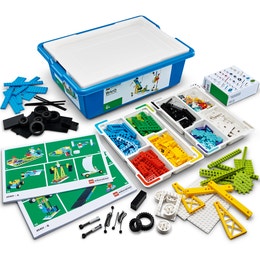
Gifted education teacher JoAnn Wann uses the Green City Challenge with LEGO® MINDSTORMS® to teach her class about robotics because the Activity Pack provides, “engaging lessons that cause students to go a step further in their learning. The materials are perceived as fun, which causes an intrinsic motivation for students to problem solve.”
The Green City Challenge is a step-by-step introduction to LEGO MINDSTORMS robotics that includes activities that teach students to program and master MINDSTORMS by using real-world engineering challenges based on renewable energy. JoAnn especially likes that there are three levels of instruction that allow for individual differences and rates of learning. Students start building and programming with Level 1, which is simple, and progress to Level 3, which is quite advanced. One of JoAnn’s students said, “Robotics is challenging. You work really hard!”
JoAnn explained that when using the Green City Challenge, her classroom is like a laboratory where students have fun using their creativity, logic, and problem-solving skills while learning key STEM concepts. Another student said, “I learn best when I can experiment and do hands-on learning.” Troubleshooting, research and development, invention, innovation, and experimentation are all part of the process that students go through to solve the challenges. The design process is the fundamental problem-solving process used in the Green City Challenge. Each lesson begins with identifying and defining a problem. To be successful, students must understand the problem. After investigation and research, students work in teams to arrive at the design that best fits their needs. As they test and evaluate their solutions, they often find that there are many correct answers. In JoAnn’s words, “It’s in this discussion amongst each other that allows students to find the elegant solution.” ”
![]() |
Now through May 31, 2012, receive 5% off select Green City items! Offer applies to online orders only. |
April Featured Teacher
Fifth-grade teacher Scott Roper constantly strives to demonstrate to his students how the concepts they learn in the classroom are valuable in the real world. For Scott, the LEGO® Education WeDo™ Robotics platform is the right solution for applying math and science skills in his classroom. Through building and programming WeDo models, students gain experience with mechanical and program engineering through problem solving. The increased level of engagement and excitement that WeDo brings to Scott’s classroom is evident by the fact that his students are motivated to intrinsically strive for a deeper understanding of what they are studying. In fact Scott said, “WeDo has changed the traditional classroom into a workplace where young mathematicians, engineers, and scientists discuss and explore solutions to problems that they may face in future jobs.” In almost all lessons taught using WeDo, Scott teaches what he calls a SMATH lesson, where science and math concepts overlap. During these lessons students often ask, “Are we studying math or science?” To which Scott replies, “Both!” The class is able to see that in the real world, engineers who are assigned to solve problems will rarely look at one area of curriculum in isolation, but instead use their knowledge from each discipline in order to reach a solution. By using WeDo, students get to experience this firsthand. When the students have a firm understanding that the kits are used to solve problems in math and science, they become more focused on using these tools to model and design solutions. According to Scott, “When we spend time showing our students how an engineer would use the tools, it allows them to take our math and science lessons beyond the concepts studied, which is the real power of this program.”
![]() |
Now through April 30, 2012, receive 5% off select WeDo Robotics items! Offer applies to online orders only. |
March Featured Teacher
Grant Garner, a high school teacher at Coppell High School in Coppell, Texas, uses Engineering with LabVIEW™ in his classroom. He wants to spark students’ interest in programming and allow them to make real-world connections from class to industry.
Using Engineering with LabVIEW allows students to put the engineering design process into practice. The graphics aspect of the software provides students to visually inspect their work and connect it to the design diagrams, which they made prior to initiating their solutions in the programming environment. The open-ended challenges and real world scenarios provided by Engineering with LabVIEW stimulate students to learn more about programming and according to Grant, “the graphic based system has appealed to many students that never would have considered programming in the past.”
The software not only gets students interested in programming, but also “allows students to explore multiple aspects of engineering and is a great window into various fields,” said Garner. In fact, the reason Garner has been using the software for the past five years is because it is reflective of what students might actually see in college and industry.
February Featured Teacher
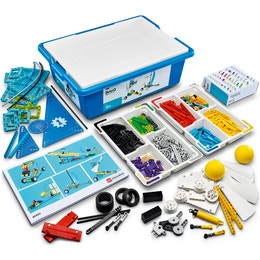
Fifth-grade teacher Mark Gullickson uses the Simple and Motorized Machines Sets to teach science, math, and basic engineering classes at Central Elementary School. He finds that when LEGO® Education products are used in the classroom, student interest and engagement go up immediately. Because there is a high interest level, using the Simple and Motorized Mechanisms Sets has been a great way to engage reluctant learners. The sets help students stay especially interested in math and science, which helps grow and maintain academic performance of the students. In fact 90% of the students in Mark’s classroom have either met or exceeded the state of Oregon math and science test standards. “I contribute part of my students’ strong academic success to the hands-on, project-based learning opportunities that the LEGO Education system for learning has provided for them.”
Not only does Mark find the Simple and Motorized Mechanisms Sets helpful in the classroom, he also uses them to help his FIRST® LEGO League (FLL) teams develop an understanding of basic math and engineering principles. Combined with the Renewable Energy Add-on Set, these materials help FLL teams to develop a basic foundation for designing and building with LEGO gears, beams, pins, and bushings.
Whether using the Simple and Motorized Mechanisms Set in the classroom or through competitions, Mark finds that students are more likely to be engaged and feel more confident and proud of their individual successes.
January Featured Teacher
Elementary teacher Mandy Arck uses the new Simple Machines Set to teach her class about basic physical science concepts such as gears, wheels and axles, levers, and pulleys. Arck and her class were very excited to start using LEGO® Education products in the classroom. The excitement and high interest led to a positive learning experience for all students.
“The students were engaged the entire part of the lesson, really internalizing what they were learning through hands-on participation," Arck said. She found that the Simple Machines sets addressed the needs of all learners by focusing their attention on the task at hand and minimizing distraction.
The hands-on aspect of the activity was effective for the students because as one student, Rylee, said, “It helps me learn and remember because I can actually feel it and do it with my hands instead of watching the teacher do it.”
Being able to work with partners was also good for Arck’s class. “Every student did get to truly participate 100% and it was a team effort.”
The problem-solving aspect of the lesson allowed students to think about a real-world situation and brought what they were learning to life. Alignment to the core standards was important to Arck, who said she would be teaching simple machines anyway, but the LEGO Education sets made it easier for the students to learn – and also a lot more fun.
As another student, Carmen, said, “The best thing about it is that you don’t know that you are learning.”